
• The Cryptographic Anchor: Multi-Attribute Key Reuse in Human Trust

    The Cryptographic Anchor: Multi-Attribute Key Reuse in Human Trust

    In a previous post, I outlined how we can merge the corporate accountability of PKI with the organic network effects of a Web of Trust (WoT). But to understand how this works in practice, we have to look at the mathematical foundation.

    Traditional identity systems treat cryptographic keys as single-purpose tools. You have one key for encryption, one for signing, and another for authentication. If you want to prove a new attribute about yourself, you are typically forced to issue an entirely new key pair or rely on a centralized identity provider to vouch for you in real-time.

    The Human Trust model flips this paradigm. It relies on a foundational concept: the multi-attribute reuse of a single key identifier across distinct certificates.

                               ┌──► [ mTLS / CBA Cert ] ───► (Establishes secure pipe)
                               │
      [ SINGLE PRIVATE KEY ] ──┼──► [ Peer-Signed Cert ] ──► (Vouched by Friend A)
                               │
                               └──► [ Attribute Cert ] ───► (Verified Organization role)
    

    One Key, Multiple Expressions

    At the center of a user’s digital identity is a single private key and its corresponding public component (Key ID). Instead of stuffing every single piece of identity data, corporate roles, and personal relationships into one bloated, rigid certificate, this model creates an ecosystem of smaller, modular certificates orbiting the exact same Key ID.

    This architectural choice unlocks three critical capabilities shown in the image above.

    1. Progressive Trust Amplification

    An initial key pair might start with zero external validation—it simply proves possession. However, as you interact within the ecosystem, other users (acting as leaf-node signers) issue new, distinct certificates targeting your exact same Key ID. Each signature layers on top of the initial key, structurally adding trust to it over time without requiring you to cycle keys or update a central database.

    2. Contextual Isolation via Varied Attributes

    By using separate certificates for the same key identifier, you can bind completely different attributes to your cryptographic identity depending on the context:

    • The Authentication Layer: One certificate contains only the bare minimum data required to execute a secure mutual TLS (mTLS) connection or Certificate-Based Authentication (CBA).
    • The Relational Layer: A companion certificate, signed by a peer or a contact via the Web of Trust, contains metadata verifying a personal or business relationship.
    • The Sovereign Layer: Self-signed or community-vouched certificates can assert specific attributes that you control, rather than relying on a commercial root authority.

    3. “Out of Band” Discovery

    When you connect to a service provider using mTLS, your client proves possession of the private key using the primary authentication certificate. Because the service provider now holds your public Key ID, it doesn’t need to ping a centralized directory to learn more about you.

    Instead, the provider can seamlessly ingest your smaller, companion “sidecar” certificates that share that exact same Key ID. The service provider reads the peer signatures and attributes bound to those companion certificates, evaluating your trustworthiness entirely within the local context of the connection.

    Shifting the Burden of Trust from Math to Relationships

    Cryptography is exceptional at proving that a math problem was solved; it is inherently terrible at proving that a human is responsible.

    By reusing the same key identifier across a web of modular, peer-signed certificates, we change what a cryptographic key represents. It is no longer just a random string of bits used to open an encrypted pipe. It becomes a localized aggregator of human reputation—a single mathematical anchor that handles connection mechanics on one side, and carries the weighted trust of your entire network on the other.
  • Blueprint for AI Control: An Open Hybrid Trust Architecture

    Blueprint for AI Control: An Open Hybrid Trust Architecture

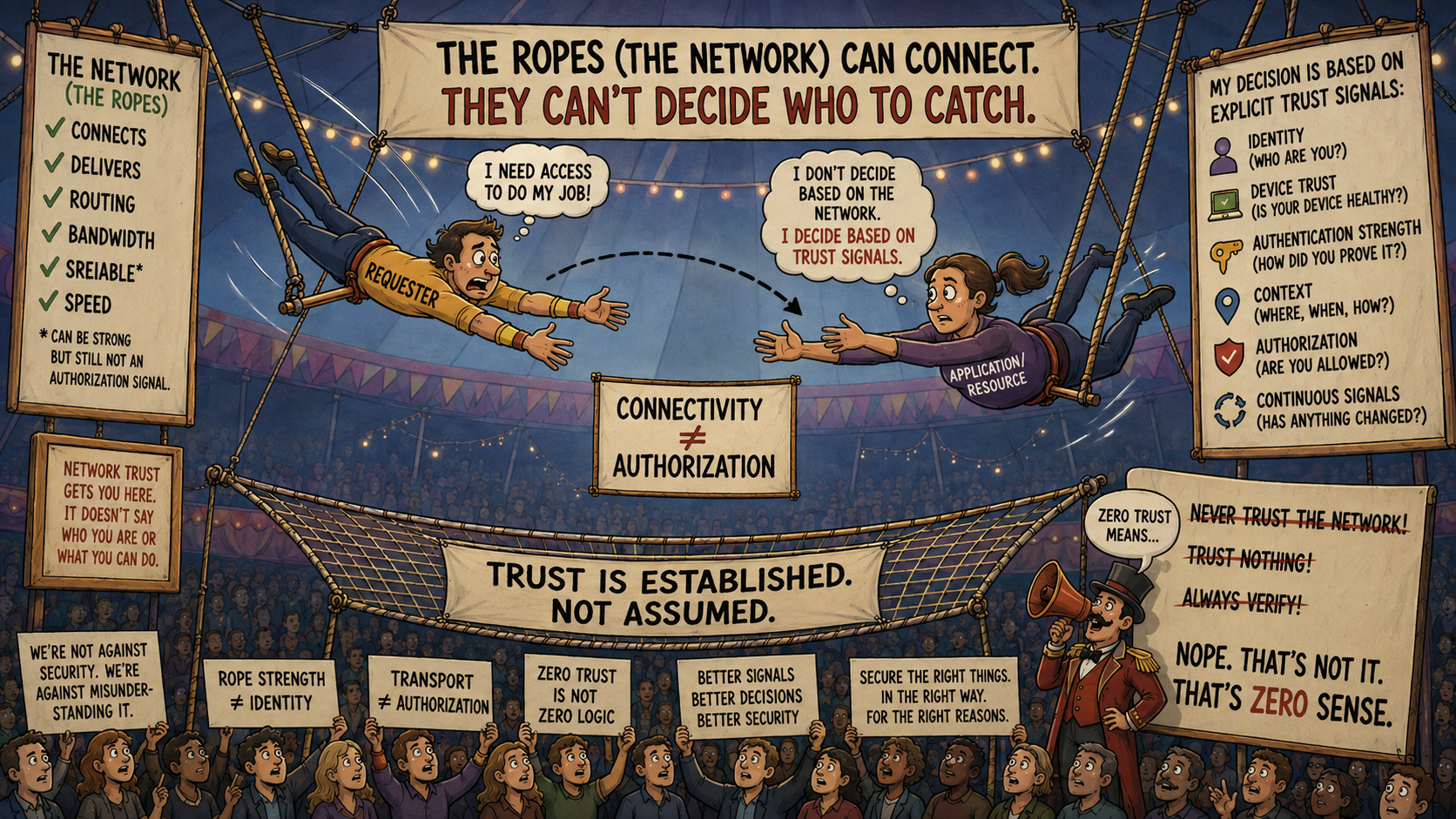
    In my previous post, I explored why the industry’s obsession with “Zero Trust” stripped away our ability to effectively manage and govern autonomous AI agents. Mathematics and cryptography are exceptional vehicles for transporting trust, but they cannot manufacture it on their own.

    To give AI agents an environment they can evaluate and respect, we must look backward to leap forward. Inspired by Stephen Marsh’s foundational 1994 paper on trust in Distributed Artificial Intelligence (DAI), I am proposing an Open Hybrid Trust Architecture. This framework bridges the structural accountability of Public Key Infrastructure (PKI) with the organic, localized validation of the Web of Trust (WoT).

    The Architecture: Top-Down Structure Meets Bottom-Up Validation

    Traditional PKI provides a rigid, binary “yes/no” validation root that corporate brands often struggle to align with globally. Pure Web of Trust models, like original PGP, are notoriously difficult for everyday users to scale. This hybrid architecture resolves both limitations by splitting responsibilities across the cryptographic tree.

    1. The Core Tree: Standard PKI Backbone

    The upper layers of the architecture utilize standard PKI hierarchies. This ensures that baseline organizational identities, regulatory compliance, and foundational trust boundaries are firmly anchored by established cryptographic roots.

    2. The Outer Leaves: The Web of Trust Layer

    Instead of treating leaf nodes as static endpoints, this architecture transforms them into active trust nodes.

    • End-User Vetting: Users are provisioned with their own Certificate Signing Certificates at the leaf level.
    • Peer-to-Peer Signing: Just as you build connections on a professional network like LinkedIn, users leverage their certificate to digitally sign the certificates of trusted friends, professional contacts, and digital agents.
    • Contextual Vetting: Signatures are based on direct human knowledge, limiting the data shared strictly to what the signer can personally verify.
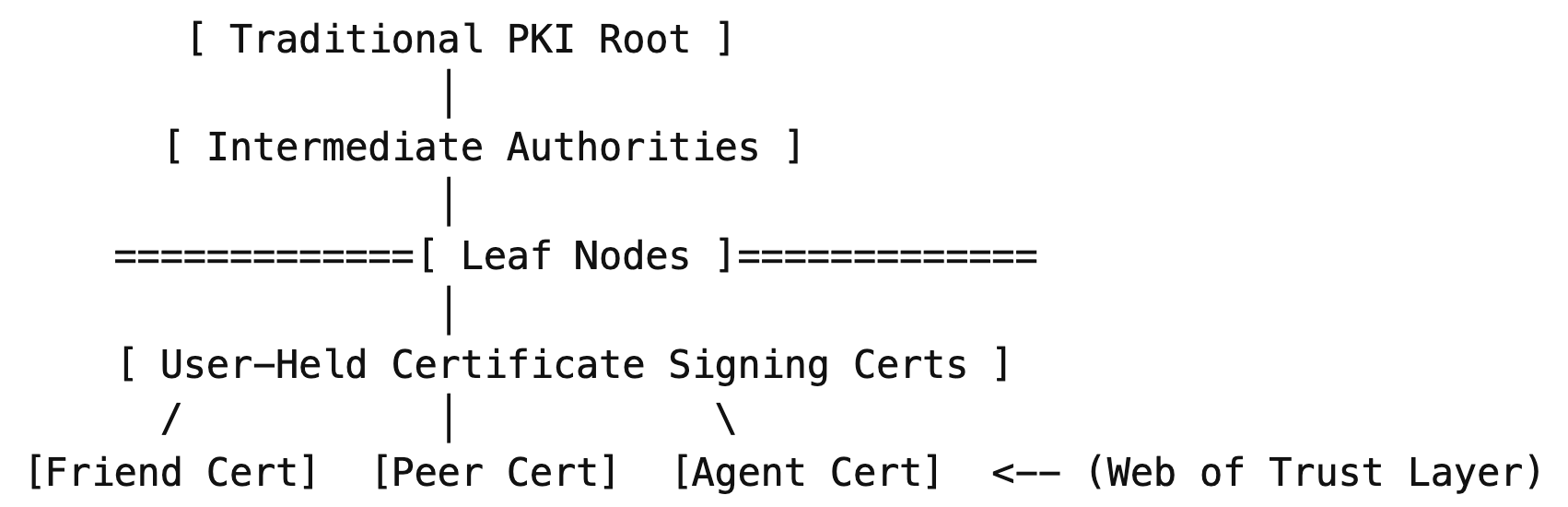
              [ Traditional PKI Root ]
                         │
             [ Intermediate Authorities ]
                         │
           =============[ Leaf Nodes ]=============
                         │
           [ User-Held Certificate Signing Certs ]
             /           │           \
       [Friend Cert]  [Peer Cert]  [Agent Cert]  <-- (Web of Trust Layer)
    

    Maximizing Utility: Multi-Certificate Key Reuse

    A critical technical feature of this architecture is the consolidation of the private key infrastructure. Users reuse a single private key / public key identifier component across multiple specialized certificates to optimize security and access overhead:

    • Proof of Possession (mTLS/CBA): The primary certificate asserts possession of the key to securely establish a mutual TLS (mTLS) connection or Certificate-Based Authentication (CBA) session with a service provider.
    • Decentralized Companion Certificates: Radiating around that exact same key identity are smaller, context-specific certificates issued via the decentralized WoT layer.
    • Granular Data Access: When an mTLS connection is established, the service provider can seamlessly lookup and ingest these peripheral, user-signed companion certificates. This allows systems to evaluate localized human relationships and contextual trust data tied to that specific key identifier, without querying a central authority.

    Why This Matters for Autonomous Agents

    AI agents require a model where they can responsibly verify who they communicate with, mimicking how humans naturally process reputation.

    By anchoring an agent’s identity to a user’s multi-certificate private key, the agent carries the weight of its creator’s peer-signed network. If an agent misbehaves, the creator has tangible social and cryptographic trust to lose. It provides a localized mathematical framework for responsibility and consequences—the two elements missing entirely from the Zero Trust paradigm.

    The use of a certificate should be verified through certificate revocation checks, preferably through the use of the OCSP protocol, where the response creates a track record of where the agent goes, and a “kill switch” that a “token” can not mimic in the same way.

    In this model, since keys are reused with longer lived certificates for “identity”, shorter certificates for “purpose” that limits the agents activity in time.

  • Why “Zero Trust” Made Us Lose Control of AI Agents

    Why “Zero Trust” Made Us Lose Control of AI Agents

    One of the most surprising turn of events during my 40-year career in information technology was the meteoric rise of “Zero Trust”. I have spent decades building trust—both with customers and within their information landscapes. Yet, the industry bought into a hype cycle that security is highest when trust is completely removed.

    The document that birthed this trend was published in 2010 by John Kindervag for Forrester, operating on the premise that the traditional “Trust but Verify” model was fundamentally broken. But by removing the very concept of trust, we accidentally stripped away our ability to govern the next generation of computing: autonomous AI agents.

    The Flaw in the Zero Trust Paradigm

    In 2011, Kindervag explained that as a network engineer, he didn’t care where data was located and trusted everything without verification. His “new” concept was simply network segmentation—using architecture to isolate data. The reality is that many organizations were already segmenting networks and verifying traffic long before 2011.

    In 2019, I presented at a Palo Alto Networks event in Dublin. Representing Okta, I demonstrated how identity can verify users within a Next-Gen Firewall. Okta’s core value was that you could trust the service and the cryptographic tokens it issued, provided you verified them using exchanged metadata.

    At the same event, Kindervag had a presentaion about Zero Trust. At the gathering concluding the event, I asked him how a firewall operates without trust, Kindervag described it as “reliance” rather than trust. This suggested to me that “Zero Trust” had become an ideological concept divorced from human-relatable trust.

    Google’s “Beyond Corp”, Same Purpose but a Relatable Name

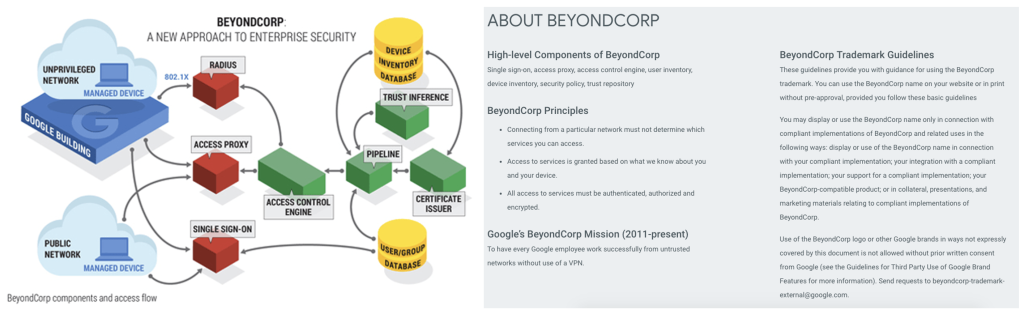
    One of the most known projects implementing some of the ideas in the report was Google’s BeyondCorp, which I believe was initiated in 2014. Maybe Google would say that this was initiated without reading the report, but the principles listed in this image are very similar, without mentioning “zero trust”. BeyondCorp also signals the purpose of the project in a way that also reflect the idea of “extended enterprise” or “modernize IT”. Google made it clear that the title of the project was a trade mark, and have since then introduced services and products under that trade mark. Three simple principles makes it simple and secure, without removing trust.

    Lessons from the Evolution of Trust Models

    Digital trust historically split into two paths in the mid-1990s:

    • Public Key Infrastructure (PKI): Corporate-driven and hierarchical, facing scaling issues, and raising questions on who to trust and why.
    • Web of Trust (WoT): Decentralized peer-verification, exemplified by PGP and modern LinkedIn, fostering responsibility through social connection.

    The Crisis of the AI Agent

    As noted in a 1994 paper by Stephen Marsh, we need trust models for autonomous systems. Today, AI agents are “breaking free” because we rely on mathematical models that can transport trust but not build it. Current initiatives, like those in the EU, often focus on ZKP (Zero Knowledge Proofs) while ignoring the necessity of responsibility and consequences.

    Conclusion: Setting the Path for Human Trust

    Since AI agents cannot evaluate trust, and traditional human anchors are weakening, a new framework is necessary. We must develop a decentralized “Human Trust” model that mirrors the peer-to-peer accountability found on platforms like LinkedIn. By using the fundamentals of PKI with trusted certificates to share trust we can get a hybrid model that is cryptographically secured, but relatable to humans. This approach emphasizes accountability over, or in conjunction with, just the mathematical verification of trust.

  • Hello Human Trust!

    Hello Human Trust!

    Welcome to Human Trust. This is our first post on this site, which will introduce a new architecture for securing identities and relationships. We are still in a proof of concept stage, and will keep the world updated on this site as we progress. We aim to launch the service and products during 2026.

    The thoughts and ideas presented here are from 40 years in the industry. Some might seem old fashioned, and som might seem fantasy. Please free to comment on any post. We will read it and get back to you if you share an email address, to discuss if you want your comment published.